
Moving Company Websites
Built To Get Found And Booked
A moving company website has two jobs: show up when someone searches, and turn that visitor into a booked move. We build for both. One of our sites converts at 27.7%. Yours can be live in about a week, and it's free while we work together.
Your Website Might Be Costing You Jobs
Most moving company websites look fine and do very little. People land, wait, look around and leave without calling. It usually comes down to four things you can't see from the outside.
Slow On A Phone
Most people looking for a mover are on their phone. If the page takes too long, they're back on Google before your logo shows up.
Hard For Google To Read
Missing titles, no sitemap, one page trying to cover every service and every city. Google can't rank what it can't understand.
No Clear Path To A Quote
A buried phone number, tiny buttons, a form that asks the wrong things. Every extra step costs you a booking.
Nobody Watching The Numbers
If no one checks how many people found you and how many clicked, the site never gets better. It just gets older.
A Tenth Of A Second Is Worth Real Money
At the end of 2019, Google asked Deloitte and the agency 55 to answer one question: what happens when a mobile site gets just 0.1 seconds faster? They tracked 37 brands and more than 30 million visits for a month.
More Visitors Reached The Lead Form
On lead generation sites, 21.6% more people made it to the form submission page. Retail sites saw 8.4% more conversions. All from a tenth of a second. The study is called Milliseconds Make Millions.
A moving company website is a lead generation site. Its whole job is getting someone to that quote form. So speed isn't a nice extra for us. It's where the build starts.
Google grades every site on three measurements it calls Core Web Vitals. In plain words:
It Loads Fast
The main content should show within 2.5 seconds. Google calls this Largest Contentful Paint.
It Reacts Fast
When someone taps a button, the page should respond within 200 milliseconds. That one is Interaction to Next Paint.
Nothing Jumps Around
Buttons and text shouldn't shift while the page loads. Google wants a layout shift score of 0.1 or less.
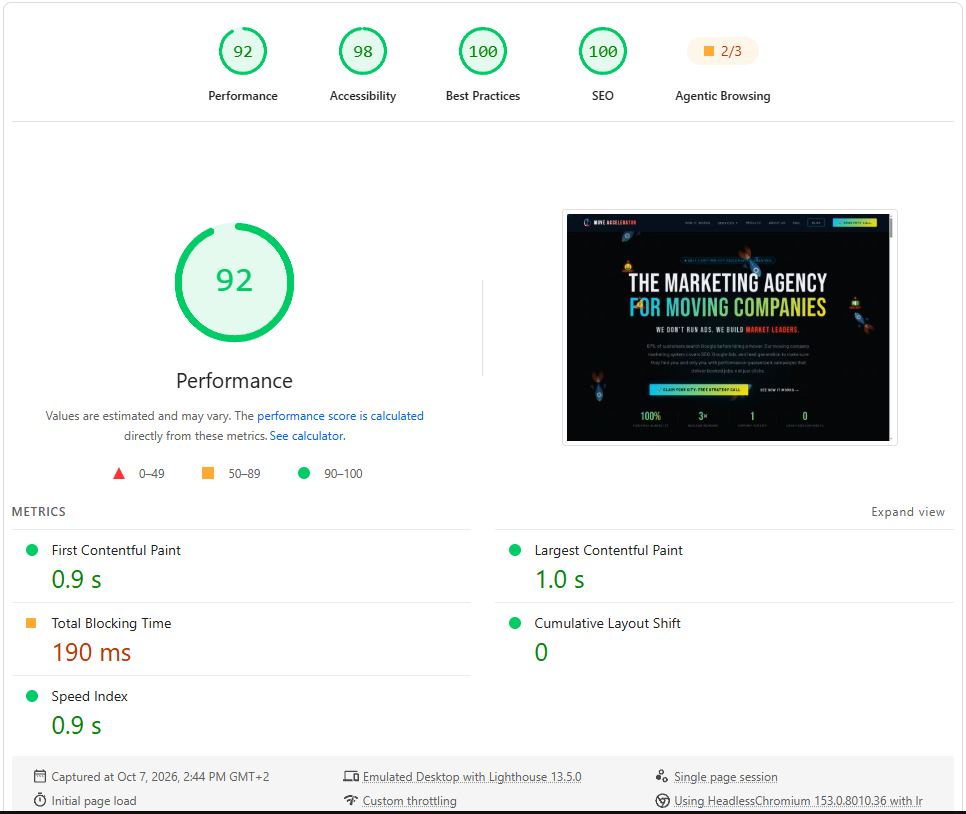
A desktop PageSpeed test of our own site, October 2026. Main content in 1.0 second, zero layout shift, and 100 for both SEO and best practices.
Google Has To Find You Before Anyone Can Book You
Speed only matters if people arrive. These are three things we set up on every site, so Google reads it properly and you can see what's working.
A Title And Description Written To Get The Click
Every page gets its own title and description. That's the blue link and the two lines under it in Google. We keep the title under 70 characters and the description under 155, so they're far less likely to get cut off mid sentence.
Here's the part most people miss. Google doesn't use the description to rank you. What it does is decide whether the person who sees you clicks you or the mover listed below you. So we write it like an ad, not like a label.
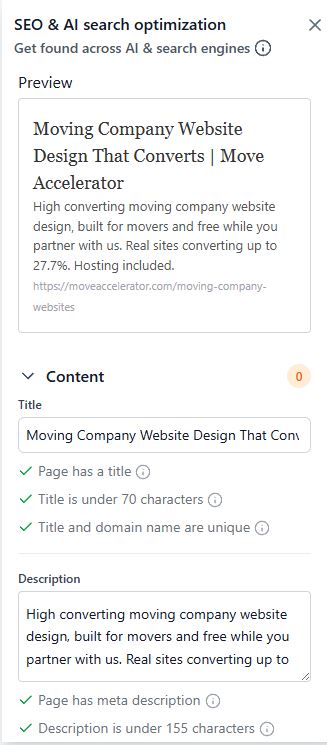
The title and description panel for one of our own pages. Every check passed.
A Sitemap Google Can Actually Read
A sitemap is the list of pages you hand to Google, so it doesn't have to guess what exists. We create it, submit it in Google Search Console, and check that Google read it without errors. Every time a new page goes live, the sitemap gets updated.
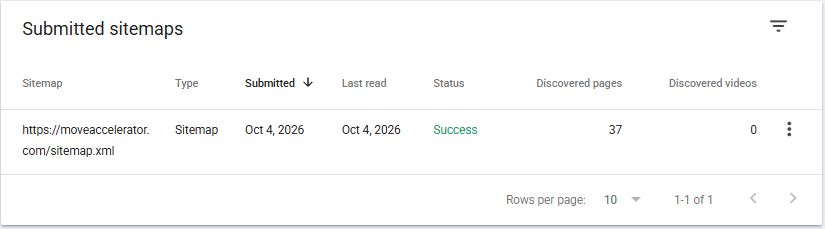
Our own sitemap in Google Search Console. 37 pages discovered, status Success.
Clicks And Impressions, Tracked From Day One
Impressions are how many times your site showed up in a search. Clicks are how many people chose you. Every site we build is connected to Search Console at launch, so we can see which pages and which searches bring people in, and fix the ones that don't.
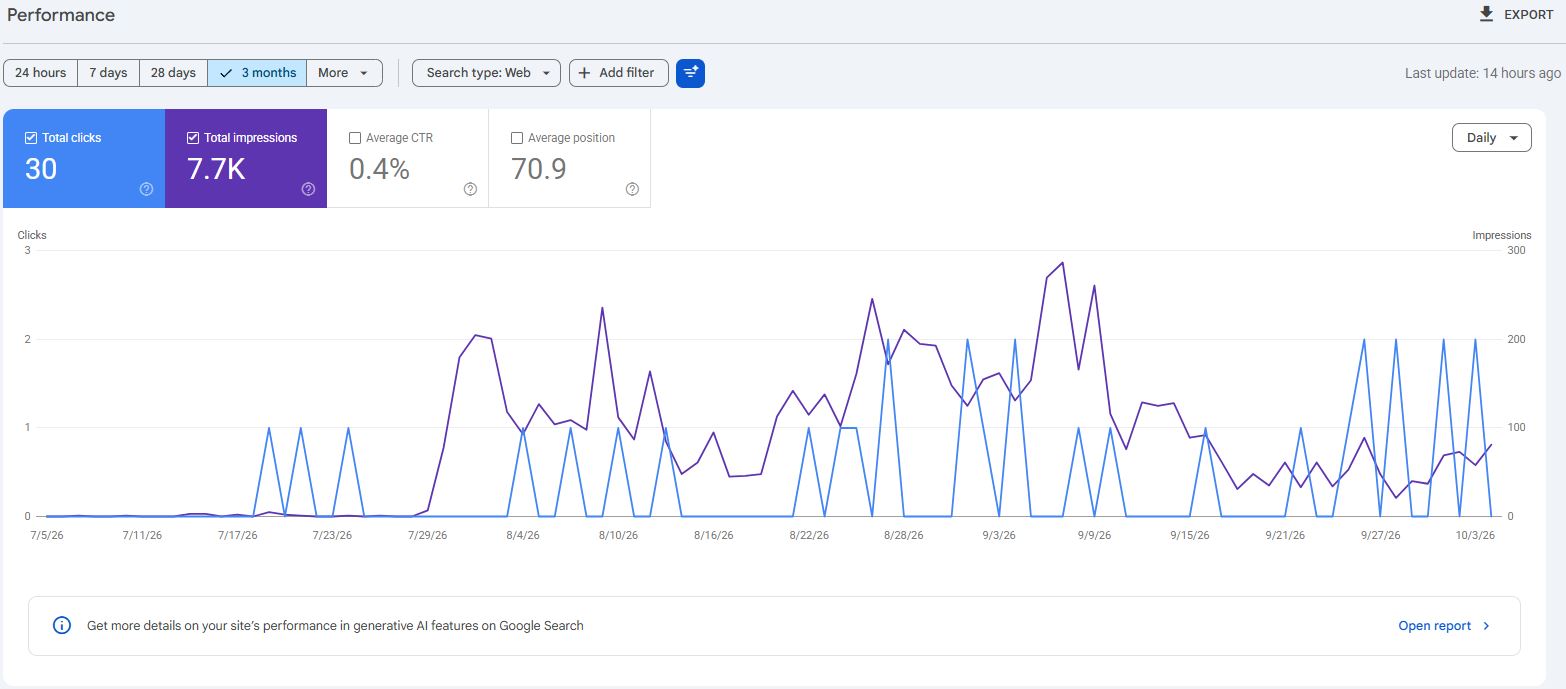
What we watch for every site: clicks and impressions, day by day.
Tracking tells us what to fix. Pushing those numbers up is the job of SEO for moving companies.
Every Page Has One Job
Google ranks pages, not websites. One page that lists every service and every city can't rank well for any of them. So each thing people search for gets its own page.
✓ The Header
Your phone number and a quote button, in reach on every page and every screen. On a phone, one tap starts the call.
✓ The Footer
Links to every service and every area you cover, plus your name, address and phone exactly as they appear on your Google listing. Customers and Google can reach every page from anywhere.
✓ A Page For Every Service
Local moving, long distance, packing, storage, commercial. Someone searching for packing help should land on a page about packing, not on a list.
✓ A Page For Every Area You Serve
Each city or neighborhood gets its own page, written for that place. For one Philadelphia client we built over 40 of them, covering city neighborhoods and suburb towns across three counties.
✓ Route Pages For Long Distance Moves
People planning a long move search for the exact trip, from one city to another. We build pages for the routes you actually run. How we build them stays with us.
✓ Built The Way Google Asks
Google treats copy and paste city pages as spam. Every area and route page has to earn its place with real, useful information about that place or that trip.
Want to see how the strongest sites lay out their pages? We broke down the best moving company websites and what each one gets right.
Photos That Help You Rank Without Slowing You Down
Real photos of your trucks and crew build trust faster than anything else on the page. They're also the most common reason a moving website is slow. We handle both sides.
Described For Google
Every image gets alt text, a short description of what's in it. Google calls it the most important detail you can give about an image, and screen readers read it out loud for people who can't see the photo.
Sized For The Screen
A photo straight off a phone can be several megabytes. We resize each one to the size it's actually shown at, so nobody downloads a billboard to look at a thumbnail.
Compressed And Loaded In Order
Images are compressed and saved in the right format. Anything further down the page loads only when the visitor scrolls to it.
Clear file names help too, a little. Google says they give it very light clues about an image, so we name files properly where the platform keeps the name and put the real effort into the three things above.
Colors Do More Than Look Good
Guillermo Robles is blind and uses a screen reader. He tried to order a pizza from Domino's website and app, and couldn't. He sued. Domino's took it all the way to the Supreme Court, which declined to hear the case in October 2019. The ruling against Domino's stood.
The lawsuits haven't slowed down since.
Source: EcomBack 2025 ADA Website Accessibility Lawsuit Report.
Low contrast is one of the easiest things to get wrong: light gray words on a white background that some of your customers simply can't read. No law gives private businesses an exact number, but settlements keep pointing to the same standard, WCAG Level AA. It asks for a contrast ratio of at least 4.5 to 1 for normal text.
We build to that standard from the first draft: readable contrast, described images, buttons a screen reader can name. Nobody can promise a site is lawsuit proof. In 2025, about a quarter of those suits were filed against sites that were running an accessibility widget. What works is building it right in the code.
Color also steers attention: which button gets noticed first, where the eye goes next, what feels trustworthy. We choose every color with that in mind. The details stay with us.
General information, not legal advice.
What Federal Rules Say Your Website Must Show
If you move household goods across state lines, your website counts as advertising under federal rules, and FMCSA is specific about what has to be on it. We rarely see this mentioned in website guides for movers.
Your Registered Name
Your name or trade name, as it appears on your U.S. DOT registration, in every advertisement.
Your U.S. DOT Number, In One Exact Format
The rule spells out how it has to look: U.S. DOT No. followed by your assigned number. No other format.
A Link To The "Ready To Move?" Booklet
If you have a website, it must prominently display a link to FMCSA's Ready to Move? booklet, or a true copy of it.
The rules are 49 CFR 375.207 and 375.213, and FMCSA's definition of an advertisement covers online listings. Many states add their own license rules for local moves. It comes down to a line in the footer and a link, and it's on our launch checklist for interstate movers.
General information, not legal advice. Check your own requirements with FMCSA or an attorney.
Ready For AI Search, Not Only Google
More people now ask an AI assistant to find them a mover. We've already had a strategy call booked by someone who found us through an AI answer.
Google noticed too. Its PageSpeed tool now includes an experimental check called Agentic Browsing, which looks at whether AI agents can read and use a page. It's new and it will change, so we won't oversell it. The basics behind it are ones we already build in.
Clean Structure
Real headings, real buttons, labeled forms. The same things that help a screen reader help an AI read your page.
Schema Markup
Hidden labels that tell Google and AI tools exactly what you are. There's even an official type called MovingCompany, with room for your services, area, hours and reviews.
Clear Answers
Pages that answer real questions in plain words, like what a move costs in your city. That's the kind of page AI tools tend to quote.
Built Right Shows Up In The Numbers
The number that matters most is conversion rate: how many visitors actually reach out. Here is one of ours against the industry.
Focus Movers
Baltimore, MDA brand new site built for Baltimore search, currently converting at 27.7%. Read the full story behind the number.
Read the case study →Runner Runner LLC
Philadelphia, PAFrom completely offline to a website bringing real traffic and leads. Built from zero for a hard working mover.
Read the case study →Pet Exporters
Dallas, TXA conversion built site plus a full lead system, and an SEO project now ranking number one on Google.
Read the case study →Everything In One Website. Nothing Left Out.
Every site we build for a moving company comes fully loaded. No upsells, no missing pieces.
✓ Fast On Every Phone
Most movers are found on a phone. Your site is built and tested to load fast and work properly on every screen size.
✓ Built For Google From Day One
Titles, descriptions, headings, schema and a page for every service and area, so the site is ready to rank from launch.
✓ Clear Calls To Action
Click to call, short forms, obvious next steps. We remove every bit of friction between a visitor and a booking.
✓ A Quote Form That Asks The Right Things
Move date, from and to, home size, stairs or elevator. Enough to price the job, short enough that people finish it.
✓ Reviews And Trust Built In
Your reputation, front and center, placed where it convinces a nervous customer to call.
✓ Sitemap And Search Console Set Up
Submitted, connected and checked at launch, so Google knows every page and we can see every click.
✓ Ongoing Improvements
We don't set it and forget it. We keep refining your site based on real data as the leads come in.
✓ Free Hosting, Handled For You
Hosting is included and fully managed while you partner with us. One less thing you ever have to think about.
A website is the base everything else stands on. How it looks, reads and earns trust is its own subject, covered on our moving company website design page. Pair the site with Google Ads for moving companies to get calls from week one, and see how it all fits into moving company lead generation.
Live In About A Week
We've built enough mover sites to know what works, so we don't start from a blank page. We start from layouts already proven on moving company websites and shape them around your market.
Research
We study your city, your customers and the movers ranking above you before anything gets built.
Build
Your pages go together on a proven layout: services, areas, quote form and reviews.
Launch
Speed tested, sitemap submitted, Search Console connected. Then it goes live.
Improve
We watch what real visitors do and keep tuning the site as the leads come in.
The site you're on right now, moveaccelerator.com, was built the same way.
Your Website Is Free
While We Work Together
When you partner with us on your marketing, we build your website at no cost and host it free too. No big upfront invoice and no separate web design bill. It's all part of being our partner.
And it stays yours. If we ever stop working together, you keep the website and we help you move it. Or leave it where it is, with hosting and support from around $100 a month.
One moving company per city. When your city is taken, it is taken.
Moving Company Website Questions
How much does a moving company website cost?
When you partner with us on your marketing, the website is free to build and free to host. If we ever stop working together, you keep the site, and hosting with support starts from around $100 a month depending on how many changes you need.
How long does it take to build a moving company website?
About a week in most cases. We start from layouts already proven on moving company websites and shape them around your market. Sites with a lot of area pages or fully custom work take longer.
Do I own the website if we stop working together?
Yes. You keep the website. It's written in code, so we help you move it to wherever you want it. You can also leave it with us on a hosting and support plan.
What pages does a moving company website need?
A home page, a page for every service, a page for every area you serve, a quote or contact page, an about page, reviews and an FAQ. Long distance movers also benefit from pages for the specific routes they run.
How fast should a moving company website load?
Google's own targets are a good guide: main content visible within 2.5 seconds, a response within 200 milliseconds when someone taps, and a layout shift score of 0.1 or less.
Does my moving company website need to be ADA compliant?
No law gives private businesses an exact technical standard, but thousands of website accessibility lawsuits are filed in the US every year, and settlements usually point to WCAG Level AA. We build to that standard. This is general information, not legal advice.
Do I have to show my USDOT number on my website?
If you move household goods across state lines, federal rules require your registered name and your number in every advertisement, written as U.S. DOT No. followed by the number. Your site must also link to FMCSA's Ready to Move? booklet. Many states have their own rules for local movers.
Do you build websites for junk removal companies too?
Yes. We work with moving and junk removal companies only, and we take one company per city.
Ready For A Website
That Actually Works?
Let's talk about your market, your goals, and the website we would build for you. Free strategy call, no pressure, and your city might still be open.
🚀 Book Your Free Strategy Call
The moving company marketing agency. SEO, Google Ads, websites and lead generation built exclusively for moving and junk removal companies. One city. One partner. Total domination.
© 2026 Move Accelerator. All Rights Reserved. Built to dominate. Designed to win.
Privacy PolicyTerms And Conditions
ONE CITY. ONE PARTNER. TOTAL DOMINATION.