
When the Great Depression hit, Kellogg's board did what most boards do in a bad year. They voted to cut advertising. Then W.K. Kellogg came back from California, called a meeting, and told his officers to press ahead. They voted again, and this time they added $1 million to the advertising budget. Sales kept rising all the way through the Depression (Kellogg Company history).
Fifty years later, McGraw-Hill Research followed 600 companies through the recession of the early 1980s. By 1985, the companies that kept advertising hard had grown their sales 256% more than the ones that pulled back (Branding Strategy Insider).
Every November, moving companies run their own small version of that experiment. The phones get quieter, crews have empty days, and the first thing that gets cut is marketing. But people don't stop moving in winter. Fewer companies are fighting for them. This guide shows where the winter moves come from, what clicks and leads really cost, and exactly what happened when one of our clients had a bad September and decided to push instead of pause.
of US moves happen outside May to August (moveBuddha)
household moves fall between November and February (TransUnion)
average click for home services search ads (LocaliQ, 2026)
per lead for our client Focus Movers in October
The Moves Don't Stop In Winter
Summer is busy, no argument there. But "busy season" makes it sound like the rest of the year is empty, and the numbers say otherwise. moveBuddha puts 41% of US moves between May and August (moveBuddha). Flip that around and 59% of moves happen in the other eight months.
TransUnion looked at household moves month by month over several years (2007 to 2014). January was the quietest month, and even January held 6.7% of the year's moves. November to February together made up 30.9%, almost one move in three (TransUnion).
| Month | Share of household moves |
|---|---|
| October | 9.0% |
| November | 8.5% |
| December | 8.5% |
| January (the slowest month) | 6.7% |
| February | 7.2% |
| March | 7.4% |
| April | 7.7% |
| August (the busiest month) | 10.1% |
Source: TransUnion, household move activity 2007 to 2014. Different sources measure moves differently, so treat the exact shares as a guide. The pattern is the point: winter is slower, not empty.
So who moves when it's cold? The same people as always, plus a few groups that show up more in winter:
- Renters chasing a deal. Apartment List finds rents are cheapest in November and December, with winter savings of around 1.6%, or $50 to $100 a month (Apartment List). Plenty of renters time their lease for exactly that.
- People who can't wait. A new job, a divorce, a parent who needs help, a house that finally sold. Life doesn't check the moving calendar.
- Tax refund movers. The average IRS refund this year was $3,276, up from $2,939 the year before (IRS). Refunds land in February and March, and for a lot of families that's the moving money.
- Offices and businesses. Commercial moves follow leases and budgets, not the weather. Many companies plan moves around the end of the year. We cover how to win them in commercial moving leads.
- Seniors and downsizers. Often planned around the holidays, when the family is in town to help decide.
The quiet advantage. In winter you're not just fighting for fewer customers. You're fighting fewer movers for them, because many of your competitors just switched their ads off. The customer who searches "movers near me" in January sees fewer ads, and the ones still showing get the call.
Our Story: 52 Leads In September, 108 In October
Focus Movers is a moving company in Baltimore, and one of our partners. We run their Google Ads and their website, and we publish their numbers on our Focus Movers case study.
August was their best month. For roughly $2,600 to $2,700 in ad spend, the campaigns brought in more than 80 leads, at about $32 per lead.
September hurt. Same budget, and the leads dropped to 52, at over $50 each. Peak season was ending, and on paper this is the moment every agency sends a report that says "it's the season" and waits for spring.
We picked up the phone instead. I called the owner and we went through everything together: what the market was doing, what kind of calls were coming in, the quality of the leads, what customers were asking about, and what we might need to change. We pulled all the data from the month and looked at it side by side.
Then the owner invited us to a meeting with Google's own representatives. We went together, showed them the account, and got their feedback. Some of it confirmed what we already saw in the data. Some of it gave us new things to test.
We made the changes, and we added $300 a month to the one campaign that was clearly working. That was the only budget change.
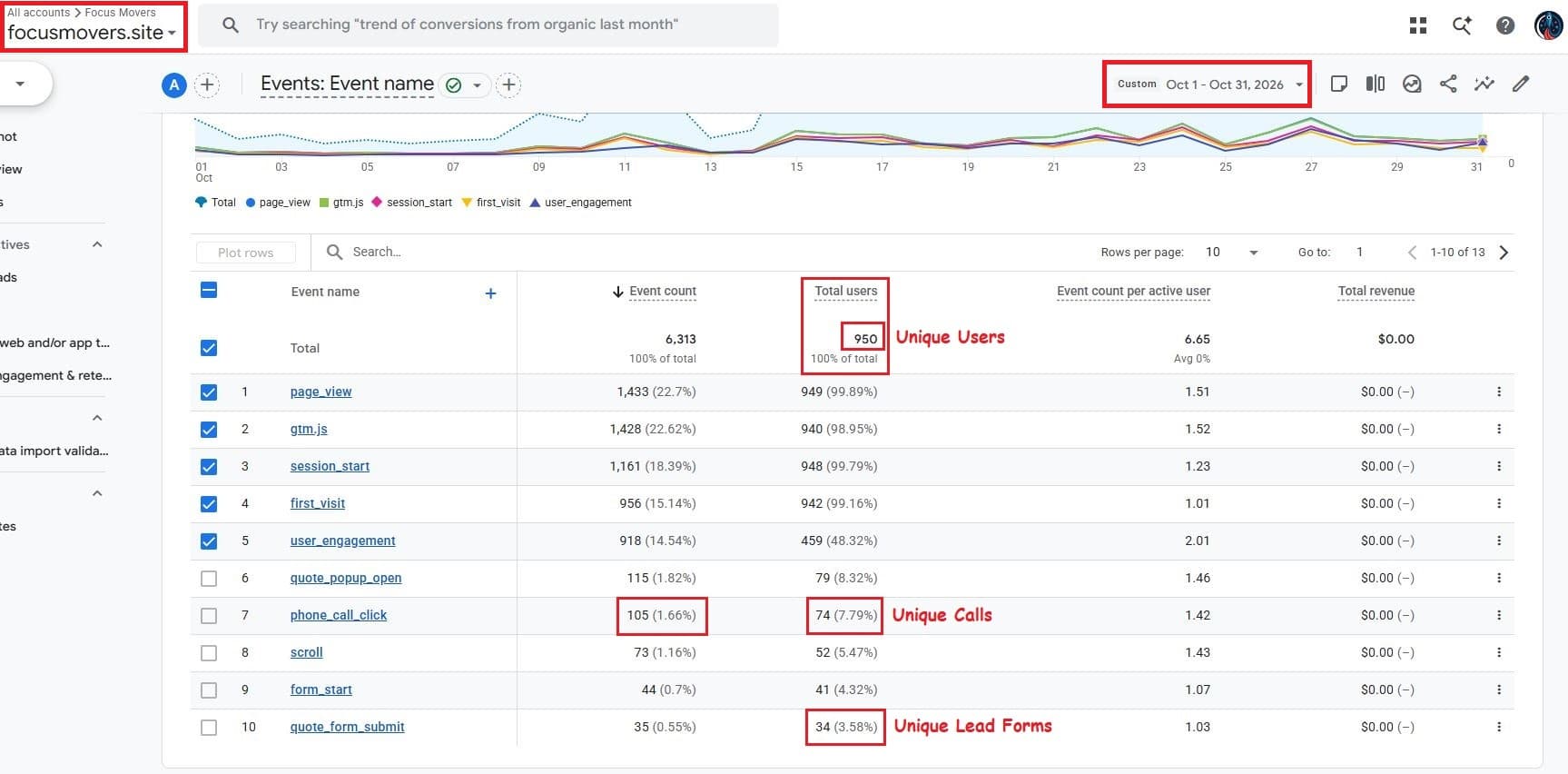
Focus Movers, October 1 to 31, 2026, from Google Analytics: 950 visitors, 74 people tapped to call, 34 people sent a quote form.
September
52 leads at over $50 each, on the same budget as August.
October
108 unique leads: 74 callers and 34 quote forms, at about $27 each.
More than double the leads, for about half the cost per lead, in the month the industry slows down. The October numbers count unique people, so someone who called twice counts once.
We're not going to pretend there was one magic setting. There wasn't. What made the difference was that the owner and the agency treated a bad month as a problem to solve together, with real data and a direct line to Google, instead of a reason to blame the season. The checklist we used is in the playbook below.
"Clicks Cost $50 To $150." Here's What They Really Cost
We talk to moving company owners every week. A lot of them have been told by someone that clicks in their city cost $50 to $150, and that $150 to $450 per lead is just what moving leads cost. Some of them believe it so firmly that they've stopped advertising altogether.
That's not what the data says. In LocaliQ and WordStream's 2026 benchmarks, built on 13,474 US search campaigns, the average home services click costs $8.33, 8.05% of clicks turn into a lead, and the average cost per lead is $90.92 (LocaliQ, WordStream). Even in a pricey market like Boston, one agency puts moving clicks at roughly $8 to $18, with only the most urgent searches going past $25 (Netpeak).
| Per click | Per lead | |
|---|---|---|
| What many movers are told | $50 to $150 | $150 to $450 |
| Home services average (LocaliQ, 2026) | $8.33 | $90.92 |
| Focus Movers, October 2026 | Not shown | About $27 |
So where do the scary numbers come from? Usually from simple math working against you. Cost per lead is the price of a click divided by how often a click becomes a lead. A $10 click on a page where 2 visitors in 100 call you is a $500 lead. The same $10 click on a page where 10 in 100 call you is a $100 lead. Same ad, same city, five times the price. That's why we say the ad sells the click and the page sells the call (more on that in a moving company website that converts).
The other usual suspects are money leaking to the wrong searches and the wrong areas. We list all ten in Google Ads for movers: 10 budget leaks. If someone quotes you $150 or more per lead, ask them to show you the click price and the conversion rate behind it. One of the two is almost always fixable.
Is Your Cost Per Lead Normal? Check It
Put in last month's numbers. The defaults are Focus Movers' September: about $2,600 for 52 leads. The booking rate and average move are only examples, so change them to yours. Nothing you type leaves your browser.
The $150 bar is the low end of what many movers are told leads cost. The average is LocaliQ's 2026 home services benchmark.
The Slow Season Playbook
This is the checklist we went through with Focus Movers, plus what we do with every client when the season turns. You don't need all of it. Start at the top.
Don't switch your ads off. Trim them.
Campaigns learn from their own results. Google says new bid strategies usually need a few conversion cycles to settle, and big changes can send them back into learning (Google Ads Help). Switching everything off for winter and back on in spring means starting that learning again right when you need it most. Keep the campaigns that book jobs. Cut the hours nobody answers, the zip codes that never book, and the services nobody asks for in winter.
Get on a call when the numbers drop
One bad week is noise. A bad month is a signal. Sit down with whoever runs your ads and go through it together: which searches brought calls, which calls were real moves, which zip codes booked, and what customers kept asking about. The owner hears things on the phone that no report shows, and the agency sees things in the account the owner never looks at. You need both.
Talk to Google
Google Ads has its own support team, and many advertisers get calls or meeting invites from Google representatives. Take them, and bring your agency. Google sees patterns across thousands of accounts. They won't run your campaign for you, but a second opinion from the people who built the system is worth an hour.
Move money to what's working
Our October jump came from adding $300 a month to one campaign, not from doubling the budget. In the slow season, look at which campaign brings the cheapest real leads and give it a little more room, instead of spreading the same money thinner.
Don't fight the whole season with a setting
Google Ads has seasonality adjustments, but Google says they're made for short events of one to seven days and may not work as well over periods longer than 14 days (Google Ads Help). For a slow season that lasts months, Smart Bidding already adjusts. Your job is the data it learns from: count only real leads as conversions.
Answer every call like it's the only one
Fewer leads means each one is worth more. A winter customer who calls and gets voicemail calls the next mover on the list. Answer live, call back forms within minutes, and see why speed to lead wins moving jobs for the research behind it.
Go back to everyone who didn't book
Every quote from the summer that didn't book is a person who was planning a move. Some of them postponed it. A short text in November with open dates and a flexible weekday rate brings back jobs you already paid for once. More ideas in how to get more moving jobs.
Speak to the winter customer
Write ads and page headlines for the people who actually move now: "Open dates this week", "Weekday rates for flexible moves", "Office moves over the holidays". Then get ready for tax refund season in February and March, when a lot of postponed moves come back.
Use the quiet weeks to build
Slow weeks are when you finally have time for the work that pays in spring: fixing your website, getting reviews from this year's customers, and starting on SEO. Begin with our moving company SEO beginner guide and how to get more Google reviews.
One question for your agency. Next time your leads drop, ask: "What did you change?" If the answer is "nothing, it's the season", you've learned more about your agency than about the season.
If you want to plan how much to spend before spring, our moving company marketing budget calculator works backward from the number of moves you want. And to see how we run Google Ads for movers, with two more months of Focus Movers' numbers, read Google Ads for moving companies.
FAQ
When is the slow season for moving companies?
Roughly October through April, with January usually the quietest month. Peak season runs from about May to September. Even so, TransUnion's data puts almost one in three household moves between November and February, so winter is slower, not empty.
Should I turn off Google Ads in the winter?
Usually not. Campaigns that go quiet for months have to learn again when you restart them, and many competitors switch off in winter, which leaves more room for the movers who stay. Trim instead: cut unprofitable hours, areas and services, and keep the campaigns that book jobs.
How much does a Google Ads click cost for movers?
LocaliQ's 2026 benchmark for home services search ads is $8.33 per click. Big, competitive cities cost more, often somewhere around $8 to $18, and urgent searches can go higher. If you're being told $50 to $150 per click, ask to see the account data behind it.
What is a good cost per lead for a moving company?
The home services average is $90.92 per lead (LocaliQ, 2026). It varies a lot by city, channel and how well your website converts. Our client Focus Movers paid about $27 per lead in October 2026. If you're paying $150 or more, check your click price and your landing page conversion rate first.
How do moving companies get jobs in the slow season?
Keep your best ads running, answer every call fast, follow up on summer quotes that didn't book, offer flexible weekday rates instead of discounting everyone, chase commercial and office moves, and get ready for tax refund season in February and March. Use the quiet weeks for reviews, your website and SEO.
Are moves cheaper in the winter?
Usually, yes. With fewer jobs on the calendar, many movers offer better rates and more open dates from October to April. Rents also tend to be lowest in November and December, which is one reason renters move then.

Goran is co-founder of Move Accelerator, a marketing agency that works only with moving and junk removal companies. Before marketing, he spent 10 years in customer service, which is why every campaign starts with what the customer actually searched and what they need to see next. He writes about what's working for movers right now, including the parts most agencies keep quiet.
Connect on LinkedIn →Slow Season Doesn't Have To Mean
Slow Phones
Book a call and we'll look at your last two months together: your leads, your cost per lead and where the money goes. Your ad budget stays in your own account. One moving company per city. See if yours is still open.
🚀 Book A Free Strategy Call