
Every mover in New York is talking about Piece of Cake right now. Even the big, established companies feel it. But here is the part most people miss: less than a decade ago, Piece of Cake was one truck. They didn't beat New York's oldest moving brands by outspending them. They beat them by showing up where those brands weren't looking.
One Truck Against The Giants
Voyo Popovic's first job in the industry was as a helper on a truck for one of New York City's largest moving companies. At 24, he bought a single truck for $20,000 and started his own company. (Entrepreneur covered the full story.)
His first big marketing decision wasn't a budget decision. It was a visibility decision. He painted his trucks hot pink and purple so they would stand out from the hundreds of other moving trucks on New York streets. In a city where every truck blends together, his couldn't be missed.
The second decision was about experience. He treated every touchpoint as part of the marketing: the first phone call, the emails, moving day, the follow-up afterward. Happy customers left reviews and told their friends, and that flywheel did what ad spend alone never could.
Within three years, Piece of Cake was competing with New York's largest and oldest moving brands, after growing 360 percent in a single year (Fortune). Today it runs more than 100,000 moves a year with around 350 trucks, has passed $100 million in revenue, and got there without outside investment.
$20,000 to start
growth in a single year
in revenue today
outside investment
Here is the uncomfortable part for everyone else: Piece of Cake is now the giant. And the playbook that let them win is the same playbook available to the next small mover who decides to take a piece of their market.
Why Tactic Lists Keep You In Second Place
Search for "moving company marketing strategy" and you'll find the same article ten times over. Run Google Ads. Do SEO. Get reviews. Wrap your trucks. Post on social media. All true, all useful, and all missing the point.
A list of tactics isn't a strategy. If the biggest mover in your city runs the same ten tactics you do, with five times your budget, three times your reviews, and a brand people already recognize, then doing those same ten things well just means losing more slowly. You'll keep finishing second in a fight designed for the bigger wallet.
Strategy is choosing where to fight. Specifically, finding where in the customer's journey the giant is strong, and where they're absent, slow, or too big to care.
The Goliath Playbook
Patrick Bet-David's Your Next Five Moves has a section I've read three times, on how to beat the Goliath in your industry. His core point is that big players tend to get softer the more they win. They generalize, they slow down, and they lose touch with the customers who made them big. That's not a reason to fear them. It's the opening.
A few of his principles map almost perfectly onto a moving market:
- Don't fight Goliath where it's strong. Don't enter the bidding war on "movers near me."
- Don't try to be Goliath. Specialize. One customer profile, specific move types, specific zip codes.
- Master three things Goliath can't do. Be a real person on camera, respond in minutes, and know your neighborhoods better than a 350-truck company ever will.
- Move quickly. Big companies need meetings to change a landing page. You need an afternoon.
- Don't disclose your strategy. Which is exactly why this post shows the shape of our process, not the whole recipe.
If you want the full framework, this summary of Your Next Five Moves covers all twelve of his ways to beat Goliath. Better yet, read the book.
The Goliath Audit
Every move follows the same path, from the moment someone realizes they're moving to the moment they recommend you to a friend. There are eleven stages, and the platforms that matter change as the customer moves through them.
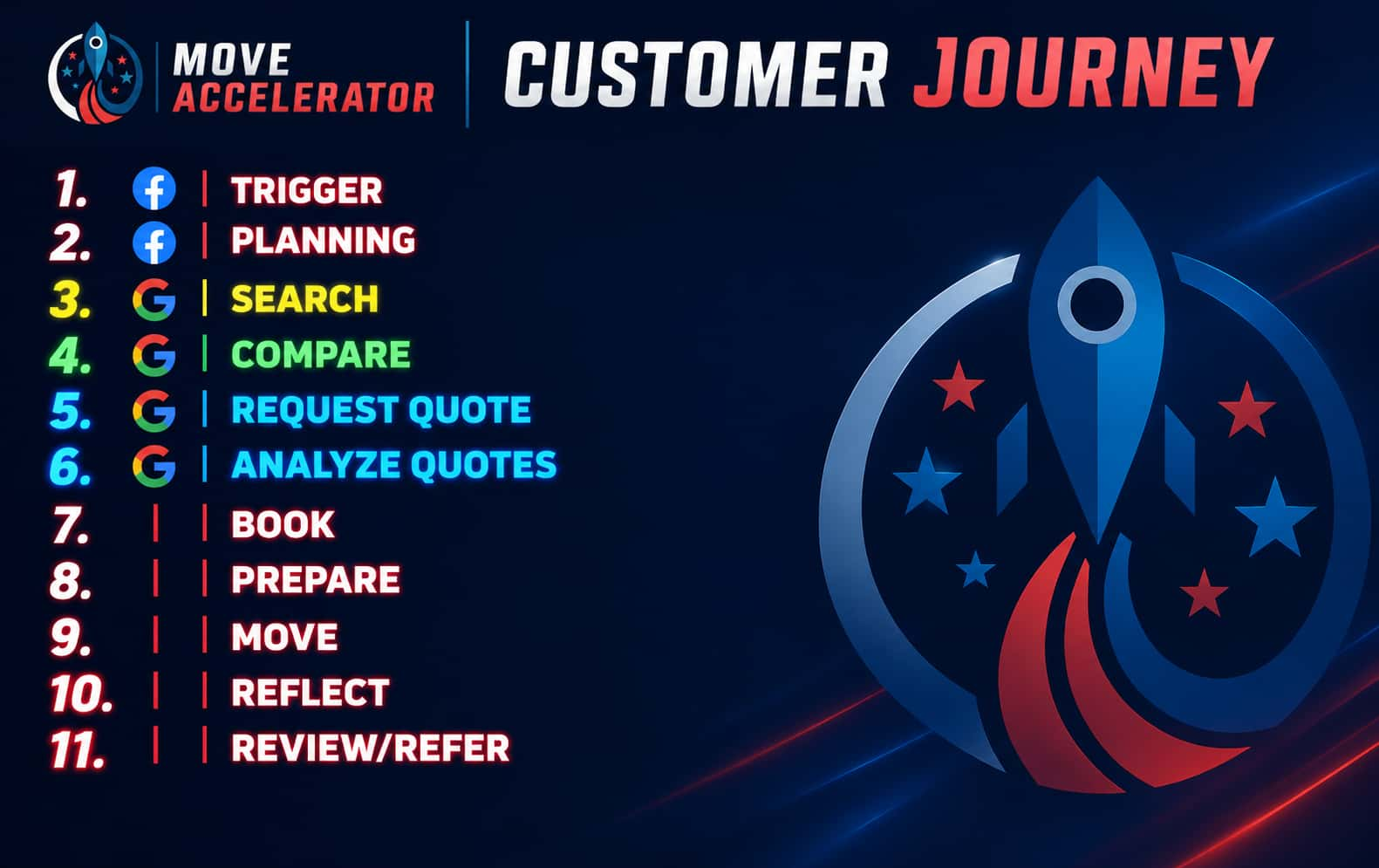
The moving customer journey. Meta owns the first two stages, Google owns the four where the decision gets made.
Now look at where most moving companies spend almost all of their energy: stage 3, Search. That's where "movers near me" happens, and it's exactly where the giant is strongest. Biggest budget, most reviews, highest bids. Everyone piles into the same stage and fights over the same clicks.
The Goliath Audit is simple. Take the biggest competitor in your market and walk through each stage asking three questions:
- Are they here at all? Most big movers do almost nothing at Trigger and Planning.
- If they are, how strong are they really? A huge Google Ads budget can still send clicks to a slow, generic landing page.
- What would it take to beat them at this one stage? Not everywhere. Just here.
You're not looking for a way to beat them at everything. You're looking for the stages where they've left the door open.
You need their blind spot.
Stages 1 And 2: Be Earlier, Not Louder
Before anyone types "movers near me," they go through two quieter stages. Trigger: the new job, the lease ending, the baby on the way. Planning: the moment the move goes from an idea to something real. People know a move is coming long before they search for a mover.
Meta lets you show up right there, while the customer is still processing that a move is happening, before panic sets in and before they've compared a single company. When they finally do search, you're not a stranger in a list of ten. You're the name they've already seen.
This works especially well in smaller cities, where Google search volume runs thin and the biggest player can buy most of the available clicks. We break down that market size effect in our Google Ads vs Facebook Ads for movers guide.
But Meta works in big markets too, under one condition: the owner shows up on camera, the right way. We live in the influencer era. People have trained themselves to attach to people, not logos, and most of them actively distrust cold corporate ads. A real owner talking straight to the camera about how his crew treats a family's things builds a kind of trust no corporate brand video can fake.
And this is the one advantage the giant can't copy. A company with 350 trucks can't be a person. You can.
Stage 3: Winning Google Ads Without A Bidding War
The fastest way for a smaller mover to burn money is to try to outbid the giant. They have more money, and at the start they will win that fight. So we don't take it.
Google doesn't hand the top spot to whoever bids the most. It ranks ads on bid combined with quality: how relevant your ad is to the search, how likely people are to click it, and how good the page is where they land. A strong quality score lets you hold a competitive position while paying less per click than the company outspending you. So we cap click prices at a reasonable rate and win on quality instead of budget.
That's the principle. Here's the work behind it.
Research Every Zip Code
Before a single ad goes live, we study each zip code in the service area: household income, home values, family size, owners versus renters, education levels, housing types, how many people move each year, and what share of them move out of the area. Two zip codes ten minutes apart can need completely different campaigns.
Build The Psychological Profile
From that data we build a profile of who is actually moving in each area, then research what they want and what they're afraid of. A young renter worries about price and speed. A family selling a $900,000 home worries about scratched floors and strangers handling heirlooms. Different fears need different words and different ads.
Pick Keywords You Can Actually Win
Instead of fighting for the same three head terms everyone bids on, we look for viable keywords where the competition is beatable, then study every competitor that shows up on each one: their ads, their offers, their landing pages.
Build Landing Pages Better Than Anything Else On The Page
Then we build landing pages that beat every one of them. Copy written for that local profile, proof placed where decisions happen, even the color palette chosen around what converts best for that audience. Google rewards the better page with a better quality score, which pushes the click price down even further.
It's a lot of work, and it's supposed to be. Plenty of agencies launch a campaign, check it once a month, and send a report. This process doesn't run that way, which is exactly why it works. We're not going to publish every step of the recipe here, but that's the shape of it.
Focus Movers in Baltimore, August, with landing pages converting over 30 percent of visitors for the month.
For context, we regularly talk to movers paying $100 to $150 per lead who have been told that's simply what their market costs and nothing can be done about it. Sometimes the market really is that expensive. Far more often, it's the cost of fighting the giant on the giant's terms. Conversion rates move week to week and no month guarantees the next one, but the gap between $32 and $150 isn't luck. It's research. See the Focus Movers case study.
Stages 4 To 6: Where Trust Gets Decided
Getting the click is only half the fight. Compare, Request Quote, and Analyze Quotes are where customers decide whether you're the safe choice. The giant usually wins here on volume: more reviews, more recognition. You win on freshness, speed, and proof.
- Review velocity beats review count. Fresh reviews from the last 90 days signal an active, trusted business, even against a competitor with ten times your total. Our reviews guide covers the system.
- Speed beats size. A big company with a call center and a queue is slow. An owner-led team that responds in minutes wins jobs the giant never knew it lost. More in our speed to lead guide.
- Your site has to sell, not just inform. Proof next to the ask, tap-to-call everywhere, a short form. We break it down in what makes a moving website convert.
The Affordable Movers Trap
Not all customers are the same, and the words you use decide which ones you attract. The most common positioning mistake we see is a mover calling themselves "affordable."
Picture the owner of a $1 million home reading that word. He's not shopping for cheap. He's looking for the people who won't scratch his hardwood or lose the box of family photos. "Affordable" tells him you're not that company, and he moves on to someone else.
Meanwhile, "affordable" pulls in exactly the customer who makes the job hardest: the price shopper. The one comparing six quotes, negotiating every line, and watching the clock on your hourly rate like a taxi meter. Those jobs cost you more in time and stress than they ever bring in.
This is where the zip code research and the psychological profile pay off a second time. Once you know who you actually want to serve, every word changes: headlines, ad copy, the photos on your site, even the questions your team asks on the phone. Specific beats loud. A message written for one clear person will outperform a generic message with a bigger budget behind it.
One honest exception: if budget moves genuinely are your market, own it on purpose. Just make it a choice, not a default word you picked because everyone else uses it.
Where To Start
Run the Goliath Audit on the biggest mover in your market, then use this to pick your first move.
| If the biggest mover in your market... | Start here |
|---|---|
| Owns "movers near me" on Google | Winnable keywords, specific move types, and the zip codes they treat as an afterthought, all built on quality score instead of bids |
| Has thousands of reviews | Review velocity: fresh reviews every week and a reply to every one |
| Has big brand awareness | Meta video with the owner on camera. A person beats a logo |
| Sounds generic and corporate | Pick one customer profile and write everything for that person |
| Answers through a call center | Speed to lead. Respond in minutes, with a real person |
| Covers the whole metro | Go deep in the neighborhoods and suburbs they barely touch |
Pick one. Not six. The whole point of finding the blind spot is putting everything you have into it before the giant notices.
Piece of Cake started with one truck and colors nobody else was using. The lesson isn't to paint your trucks pink. It's that the giant always leaves a door open somewhere, and the movers who win are the ones who go looking for it. That's what real marketing for moving companies should do: find your door, then build everything around walking through it. And because we only work with one moving company per city, the door we find for you stays yours.
FAQ
Can a small moving company compete with a big one on Google Ads?
Yes, as long as it doesn't try to win by outbidding. Google ranks ads on bid combined with quality, so a more relevant ad and a better landing page can hold a strong position at a lower cost per click. Pair that with keywords and zip codes the bigger company ignores, and budget stops being the deciding factor.
Should a moving company use Facebook ads or Google Ads?
Usually both, for different stages. Meta reaches people at the trigger and planning stages, before they search. Google captures them once they are actively searching. In smaller markets with thin search volume, Meta often deserves a bigger share of the budget.
Is it bad to market a moving company as affordable?
It depends on who you want to attract. "Affordable" pulls in price shoppers and pushes away high-value customers who care more about careful handling than the lowest price. If budget moves are genuinely your market, that's fine, as long as it's a deliberate choice.
How much should a small moving company spend on marketing?
There's no single right number. The more useful approach is to build the budget backward from the number of jobs you want to book. We walk through exactly how in our moving company marketing budget guide.
How fast does this strategy work?
Google Ads can produce leads within days, though campaigns usually need 30 to 90 days to stabilize. Meta needs about three to four weeks of data to optimize. SEO and review velocity take months, but they compound over time.

Goran is co-founder of Move Accelerator, a marketing agency that works only with moving and junk removal companies. Before marketing, he spent 10 years in customer service, which is why every partnership starts with how the owner actually runs their business. He writes about what's working for movers right now, including the parts most agencies keep quiet.
Connect on LinkedIn →Let's Find
Your Giant's Blind Spot
We'll run the Goliath Audit on your market and show you exactly where the door is open. One moving company per city. See if yours is still available.
🚀 Book A Free Strategy Call